
News

[mc4wp_form id="409"]
Jakub Jankowski new CEO of Inter IKEA Group
After 20 years at IKEA – including leading the IKEA Franchisor from 2018 and CEO of Inter IKEA Group since 2020 – Jon Abrahamsson Ring is handing over to Jakub Jankowski, currently Managing Director for IKEA Industry. Jakub will step into the role as CEO of Inter IKEA Group on 1 January 2026.   Jon Abrahamsson Ring started his career at IKEA Örebro and has had leading positions in Canada, China, the Netherlands and Sweden, including assistant to IKEA founder Ingvar Kamprad. “Big thanks to Jon for all his contributions to IKEA and for successfully leading the business through a period of global disruptions and big transformation. During his leadership, IKEA has become more affordable, accessible and sustainable. I have truly appreciated the cooperation with Jon, who always has the IKEA vision and values in the center”, says Anders Dahlvig, chairman of Inter IKEA Holding B.V. “I am happy and grateful for my long IKEA journey and proud of what we have accomplished together in this generation of IKEA. In times of turmoil and transformation, IKEA stands strong with a clear direction and good momentum, and the timing is now right to hand over and say thank you for all the passion and commitment by the 200.000+ IKEA colleagues, franchisees and suppliers. IKEA is, and will always be, in my heart”, says Jon Abrahamsson Ring.   Read more .
More
Welcome H.E. Mr Julius Liljeström, Ambassador of Sweden to the Netherlands
Photo: Frank van Beek
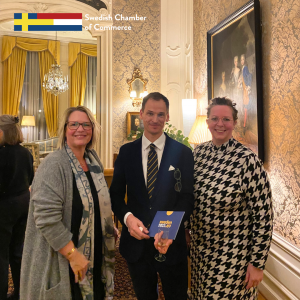
On September XX, His Majesty King Willem-Alexander of the Netherlands received the Letters of Credence of H.E. Ambassador Liljeström, formally accrediting him as the Ambassador of the Kingdom of Sweden to the Netherlands. With this ceremony at Noordeinde Palace in The Hague, Ambassador Liljeström officially begins his mission to further strengthen the close and longstanding relations between Sweden and the Netherlands.  
We are looking forward to welcoming, H.E. Ambassador Liljeström Ambassador of Sweden to the Netherlands, to the Swedish Chamber.
More
Prinsjesdag 2025
Please take part of yesterdays opening of "Prinsjesdag 2025" from Swedish Chamber Member IvCB Public Affairs & Stakeholdermanagement. Prinsjesdag 2025: Implications of Cabinet Schoof’s (Possibly Final) Budget for Swedish-Dutch Companies A guest contribution by Kevin Zuidhof, founder and Managing Director of public affairs consultancy IvCB in The Hague.   Traditionally, Prinsjesdag is the moment when the Dutch government presents its plans for the year ahead. Always on the third Tuesday of September, the King delivers the Speech from the Throne, while the Minister of Finance submits the Budget Memorandum. This document forms the core of Prinsjesdag: it outlines the economic outlook, the main policy choices, and their impact on citizens and businesses. At the same time, the State Secretary of Finance presents the Tax Plan, which contains the fiscal measures for the new year. Plans announced on Prinsjesdag typically take effect on 1 January, leaving businesses just over three months to prepare.   Prinsjesdag 2025 exists under extraordinary circumstances. Cabinet Schoof I collapsed on 3 June 2025, when the PVV withdrew after stalled negotiations on asylum policy. The crisis deepened further on 22 August 2025, when all NSC ministers resigned collectively – an unprecedented event in Dutch parliamentary history. The result is a caretaker cabinet of VVD and BBB with just 32 of 150 seats, making opposition support essential for every budget measure. The Budget Memorandum is therefore policy-light, focused on ongoing commitments rather than new plans. With final decisions postponed until after the 29 October elections, significant revisions remain possible. For businesses, this means heightened uncertainty and a clear need for agility and proactive advocacy.   In his foreword to the Budget Memorandum, caretaker Finance Minister Eelco Heinen described the Netherlands as standing at a “turning point”. He stressed the need for national and European cooperation, calling on parties to “look for where we can find each other in taking responsibility for the future of our country.” Against this backdrop, the 2025 budget is deliberately policy-light, but it does contain clear political accents that signal priorities ahead of the 29 October elections and beyond.   Fiscal reforms: relief and new pressure points Entrepreneurs face a mixed picture. On the positive side, the VAT rate on culture and sports remains at 9%, providing stability for sectors such as tourism and events, where Swedish visitors form an important part of the market. But the real headline is the extension of the fuel excise reduction for another year, costing €1.6 billion. Without it, petrol and diesel prices would have risen by roughly €0.20 per litre on 1 January 2026. For transport and logistics – crucial in Swedish-Dutch trade – this measure directly protects margins and competitiveness.   To finance this and other measures, the government is introducing targeted tax increases:
  • The labour tax credit will rise, boosting purchasing power, but funded by a slight increase in the first income tax bracket.
  • A new tax on private equity managers responds to parliamentary pressure, particularly from political party NSC.
  • The 30% ruling for expats is trimmed, reducing the net benefit for employers who rely on international staff.
  • The self-employed tax deduction will be further phased out, increasing the effective tax burden for SMEs and freelancers, including many contractors working with international corporates.
The Council of State has warned that several of these measures defer financial pain to the future, confronting the next cabinet with €135 million in additional burdens.   Labour market and talent mobility: shortages and rising costs The statutory youth minimum wage will gradually increase from 1 January 2027. However, in June the House of Representatives decided – through a motion supported by parties including PVV, PvdA/GL, D66, SP, CU, PvdD and Denk – to bring this forward to 1 January 2026, a year earlier than the caretaker cabinet had planned. For employers, this means that young staff will become significantly more expensive: for example, the minimum wage for a 19-year-old will rise from 60% to 75% of the statutory minimum wage. At the same time, from 2026 employers will be allowed to deduct 5% less per year for housing costs from wages.   Alongside the earlier youth wage increase, another important measure for international businesses is the adjustment of the 30% ruling for expats. This tax facility allows employers to pay part of the salary of highly skilled foreign workers tax-free, compensating for relocation and higher living costs. From 1 January 2027, the maximum untaxed allowance will be reduced from 30% to 27% of gross wages, while the minimum income threshold to qualify will rise to €50,436 (or €38,388 for employees under 30 with a master’s degree). For Swedish-Dutch companies that rely on international talent, this means higher wage costs, tighter eligibility, and the need to revisit HR and recruitment strategies. The measure is not yet final — it still requires approval in both chambers of parliament — but it sends a clear signal: the Dutch government is gradually scaling back fiscal incentives for expats. Swedish employers with operations in the Netherlands should anticipate the change and assess the impact on their ability to attract and retain skilled staff. The budget plans for 2026 confirm this curtailment: the maximum allowance is capped at the WNT salary norm (meaning that for high earners, the tax-free benefit stops once their salary exceeds that ceiling), and the reduced duration of five years will fully apply from January 2026. This makes hiring international staff more expensive and reduces the Netherlands’ attractiveness for top talent — a challenge for Swedish firms competing for scarce skills.   Energy and industry: decarbonisation under new conditions The budget reflects compromises in climate and agricultural policy. A €2.6 billion nitrogen package is being unlocked from a previously reserved €5 billion fund. The money will go to voluntary farm buyouts, innovation in agriculture, nature restoration, and urgent projects in heavily affected areas. This creates demand for technology and expertise – areas where Swedish companies are often strong partners.   The government has also decided to suspend the national CO₂ levy for industry, providing immediate relief for energy-intensive sectors. The 2026 budget confirms this by lowering expected revenues from the levy by €274 million, reducing compliance costs and protecting margins in the short term. From 2027, however, the picture shifts: waste incinerators (AVI’s) will face higher carbon charges, raising processing fees for packaging and recycling, while Dutch greenhouse horticulture will be brought under ETS2, adding new obligations for growers. For Swedish-Dutch companies, this means temporary breathing space in 2026, followed by rising cost pressures in recycling and agri-food supply chains in the years ahead. Companies should use 2026’s breathing space to prepare mitigation strategies for the cost increases from 2027 onward.   Beyond carbon pricing, the Climate Fund allocates €227 million to reinforce energy infrastructure, €83 million to support the transition of gas-fired plants towards CO₂-free operation, and €180 million for early-stage scaling of hydrogen and other green technologies. In addition, €47 million is channeled through the Warmtefonds to pre-finance household energy-efficiency measures ahead of reimbursements from the EU Social Climate Fund. These steps create an early market for Swedish-Dutch companies providing sustainable housing technologies, insulation, and energy-saving solutions. They also open entry points for Swedish firms with expertise in renewable energy, smart grids, and sustainable industrial solutions.   Infrastructure and logistics: investment boost and international connections The planned budget for 2026 offers only modest steps in infrastructure, with major projects such as airport and port expansions postponed to a future cabinet. Smaller measures included a one-year delay of the planned €110 million cut to urban public transport and €728 million in compensation for municipalities’ youth care deficits. The 2026 budget adds a clear cost signal: the fuel excise reduction will not be prolonged, with revenues set to rise from 2027. This points to higher petrol and diesel prices ahead — a direct pressure point for logistics and cross-border trade. For Swedish-Dutch firms active in construction, mobility, and logistics, the picture is therefore one of temporary stability in 2026, followed by growing cost burdens, while strategic infrastructure investments remain on hold until a new cabinet takes office.   Digitalisation and innovation: key to competitiveness The government continues to rely on the National Growth Fund as a driver of innovation. In 2025, €781 million has already been allocated to six promising initiatives, ranging from advanced cancer therapies to photonic chips. The emphasis is on broadly distributed investments that stimulate digital applications and R&D across multiple sectors, rather than earmarking a fixed €11 billion solely for digitalisation.   On top of that, the budget plans add nearly €0.5 billion specifically for the tech sector. This additional funding is aimed at strengthening the Netherlands’ competitiveness in digitalisation, AI, and emerging technologies. Also new in the 2026 budget is a €70 million national contribution, supported by an EU co-financing request, to establish an AI-factory with a supercomputer, data hub and knowledge centre. At the same time, Growth Fund allocations are shifted into the budget for the Oncode Accelerator (€123m) and PhotonDeltaNL (€101m).   For Swedish-Dutch companies, these measures reinforce opportunities in cross-border research partnerships, high-tech manufacturing, and digital innovation. Swedish expertise in automation, data solutions, and sustainable technologies is particularly relevant here, offering clear entry points for collaboration with Dutch counterparts.   Political dynamics: uncertainty remains Although this year’s budget is policy-light, the outcome remains uncertain. The cabinet does not hold a majority and must seek support from the opposition for every proposal. Moreover, the budgets will only be voted on after the elections of 29 October, which means that a newly elected House of Representatives could still make different choices. For companies, this makes agility and active advocacy essential to safeguard their interests.   What does lie ahead for Swedish-Dutch businesses? Prinsjesdag 2025 is politically unique: the – potentially – last budget of Cabinet Schoof I, drafted in a time of crisis. Yet its outlines matter:
  • Expect higher burdens on labour and talent mobility, as expat benefits are trimmed and wage costs rise.
  • Leverage short-term relief where it exists, such as the 2026 fuel excise extension and tech-sector funding, while preparing for cost increases in later years.
  • Seize opportunities in nitrogen and decarbonisation projects, where Swedish technology and innovation are in demand.
  • Prepare for uncertainty: budgets will be decided only after elections, and the Council of State has flagged hidden costs deferred to the next government.
Three moments will be decisive for business strategy: the 29 October elections, the coalition formation, and the December votes on the Tax Plan. Swedish-Dutch companies that stay agile, actively engage policymakers, and align their strategies with fiscal and sustainability shifts will be best positioned to thrive in the next political cycle.  
More
Welcome new Member: Solta Medical
The Swedish Chamber of Commerce is delighted to welcome Solta Medical as a new member of our growing Swedish-Dutch business community!   Solta Medical® is a pioneer and global leader in the aesthetic field addressing a range of skin treatments under the industry´s premier brands: Thermage®, Fraxel® and Clear + Brilliant®, as well as offering precise body contouring and sculpting with Vaser. Founded in 1996 by Dr. Edward W. Knowlton, the inventor of the Thermage ThermaCoolTM device. Headquartered in the US (Bothell, WA State). Present in more than 50 countries. 8 plus million procedures performed worldwide. One of the most reputable partners in the field of aesthetics. For more than two decades, Solta Medical® has been dedicated to providing exceptional solutions that deliver safe and effective results with minimal downtime. With a strong focus on patient and healthcare provider satisfaction, Solta Medical® strives to offer products that deliver lasting, visible outcomes and improved safety profiles.
More
The opening of the Riksdag session 2025
The Riksdag opened again on Tuesday 9 September. The opening marks the start of the new working year, the 2025/26 Riksdag session, for both the Riksdag and its 349 members.   The Riksdag session opens each year in September. Until 1974, the ceremony was traditionally held at the Royal Palace. Following the adoption of the 1974 Instrument of Government, the opening has since taken place in the Riksdag building. With its deep historical roots, the opening of the Riksdag session holds a distinct ceremonial significance within modern Swedish democracy.   Photo credits: Riksdagsförvaltningen
More
WELCOME NEW MEMBER: H&M
The Swedish Chamber is honoured to have H&M join our Swedish-Dutch Business Community as our new Corporate Member.   Hear from our newest member: Expanding Our Network: H&M in the Swedish-Dutch Business Community From one store in Västerås to a global fashion and design company, H&M has always believed that great style should be accessible to everyone. With 3,777 stores across 78 markets and a growing online presence, H&M offers fashion and quality at the best price in a sustainable way. The first H&M store in the Netherlands opened in the 1980s, as part of the brand’s early international expansion. The brand includes H&M HOME, H&M Move and H&M Beauty—empowering customers to express themselves through a diverse and inclusive assortment. As part of our network, H&M brings a strong Swedish heritage, a commitment to change, and a bold vision for a more sustainable fashion future.   Read more on H&M's website .    
More
Klarna lists on the New York Stock Exchange

Swedish company Klarna debuts on the NYSE as KLAR - Now everyone can own a piece of the next generation of personal finance

New York, NY, September 10, 2025 - Klarna, the global digital bank and flexible payments provider, is officially live on the New York Stock Exchange (NYSE) under the ticker “KLAR.”

CEO and co-founder Sebastian Siemiatkowski marked the occasion by livestreaming the bell-ringing ceremony on Instagram Live and X, sharing the moment with employees, partners, merchants, customers, and investors who have all contributed to Klarna’s success. Together, they celebrated this milestone, now everyone can own a piece of the next generation of personal finance.

Read more on Klarna's website .

More
Astra Zeneca expands operations in Nijmegen

Swedish Chamber Patron Member AstraZeneca expands operations in Nijmegen.

Mayor Hubert Bruls of Nijmegen officially broke ground on the expansion of AstraZeneca’s facility in the city. With a $70 million investment in sustainable medicine production, the company will add a second flexible filling line and increase its workforce from 100 to around 130 employees.

This expansion highlights AstraZeneca’s commitment to strengthening its Dutch footprint and to advancing Life Sciences & Health (LSH) through sustainable public-private collaboration and innovation.

Read more .

More

Patrons