News

[mc4wp_form id="409"]
One fifth eat plants at IKEA… and other surprising food facts
Think you know IKEA? Think again. This time, we’re putting food under the microscope. Numbers, names, successes, and failures – we’re lifting the lid on our food products. In bitesize chunks, naturally.   Our plant-based foods are going from strength to strength, with more and more customers choosing them over the meat-based versions. Last fiscal year, for example, 19% of the hot dog and ball families we sold were plant-based – that’s over 20 million plant and veggie hot dogs, and 13+ million portions of plant balls.   It’s no secret that for many of our customers, a visit to IKEA often goes hand in hand with a bite to eat. But in some countries, food plays a more pivotal role than others. In 14 Ingka markets, for example, the take-up rate in food is more than 100% – meaning that customers are more likely to buy food products whenever they visit us.   Read more .
More
After 21 Remarkable Years – CEO Kerstin Gerlagh Steps Down
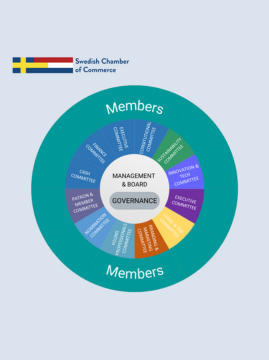
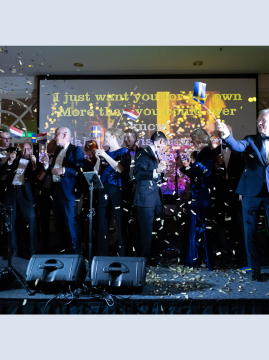
After 21 years of dedicated service, Kerstin Gerlagh will step down as CEO of the Swedish Chamber of Commerce on September 1, 2025, as she enters retirement. During her time leading the Chamber, Kerstin has played a key role in helping the organization grow and succeed, creating a lively community where Swedish and Dutch businesses can work together and support each other. She has always been passionate about bringing people together, helping young professionals, and starting projects that have made the Chamber a strong and important part of the business relationship between the two countries. To ensure a seamless transition, Kerstin will remain with the organisation until December 31, 2025, supporting the handover and transfer of responsibilities. She will be succeeded by Ms. Petra Zachrisson Beets, who will assume the role of CEO effective September 1, 2025. Kerstin Gerlagh with her successor Petra Zachrisson Beets “It has been an honour to work with an incredible network of members, partners, colleagues, and friends who all share a passion for strengthening the ties between Sweden and the Netherlands. Together, we have grown the Chamber into a dynamic hub where business and community meet — a place where ideas are exchanged, collaborations are born, and lifelong connections are made. I feel very proud and confident that the Chamber is at a very good place, we have been working hard together to set up a solid organisation with a fantastic Board, Committees, company commitments and support and member engagement. A big thank you all for the fantastic collaboration and confidence throughout my years at the Chamber it really has been an honour. I am very pleased that Petra Zachrisson Beets will succeed me as CEO from September 1, 2025 and wish her lots of success in the new role. With her vision, energy, and commitment, I am convinced that the Chamber will continue to grow and thrive in the years ahead.” - Kerstin Gerlagh, CEO Swedish Chamber of Commerce "As Kerstin Gerlagh steps down as CEO of the Swedish Chamber of Commerce after many years of dedicated service, we extend our deepest gratitude for her exceptional commitment to building an outstanding and professional Swedish - Dutch business community in the Netherlands. Under her leadership, the Chamber has flourished through numerous initiatives, such as the Young Professionals community—now exceeding 100 members—and the Mentorship Program supporting the growth and development of young professionals to name a few. Her vision also brought forward the Donut Strategy and the establishment of Chamber Committees, focused on Sustainability, Diversity, Innovation, and Branding, resulting in Member engagement and highly professional events that have strengthened and broadened our network. We are extremely grateful for Kerstin’s hard work and leadership. We look forward to a smooth handover period that will continue this strong legacy and we wish Kerstin every success in the exciting new chapter ahead." Jan Sundelin, Chairperson Swedish Chamber of Commerce for the Netherlands.

We are grateful for everything Kerstin has done over the years and for the strong foundation she leaves behind. As she steps into retirement, we wish her all the best in this exciting new chapter of her life. We are also very pleased to welcome Petra Zachrisson Beets as the new CEO starting September 1, 2025. With her energy, fresh ideas, and dedication, we are confident the Chamber will continue to grow and support our members in the years to come.

We look forward to a smooth transition and a bright future ahead for the Swedish Chamber of Commerce.

More
Relocation of Kiruna Church
The relocation of Kiruna Church is a globally unique happening taking place over two days between 19-20th August 2025.  Kiruna Church has been named Sweden’s most beautiful building and holds great cultural and historical value. Now, the church and its accompanying bell tower will be relocated, some weeks apart. The reason is the mining operations in LKAB’s iron ore mine, which are affecting the area considered the old town center, where the church is currently situated. Kiruna Church will be the largest building to be moved as part of the urban transformation that began planning over 20 years ago and has received worldwide attention. So far, 23 cultural buildings have been relocated. The church relocation will be livestreamed and is accompanied by various activities during the event.  

“This is an important and carefully planned move, and we are approaching the finish line. The church is truly unique and means a lot to many people beyond just being a landmark of Kiruna, and we want to give everyone the opportunity to follow and be a part of this historic event” says Stefan Holmblad Johansson,  project manager for the church relocation at LKAB.

  Read the press-release from LKAB .   Photo credits: Hans-Olof Utsi/imagebank.sweden.se
More
Lyten to Acquire All Remaining Northvolt Assets in Sweden and Germany
Lyten to Acquire All Remaining Northvolt Assets in Sweden and Germany 7 August, 2025 Lyten, the global leader in lithium-sulfur batteries, announced today that it has entered into a binding agreement to acquire Northvolt’s remaining assets in Sweden and Germany.   Stockholm, SWEDEN – August 7, 2025 – Lyten, the global leader in lithium-sulfur batteries, announced today that it has entered into a binding agreement to acquire Northvolt’s remaining assets in Sweden and Germany. The acquisition includes Northvolt Ett and Ett Expansion (Skelleftea, Sweden), Northvolt Labs (Västeras, Sweden), and Northvolt Drei (Heide, Germany). Additionally, Lyten is acquiring all remaining Northvolt intellectual property (IP). “This is a defining moment for Lyten,” stated Dan Cook, Lyten CEO and Co-Founder. “Lyten’s mission is to be the leading supplier of clean, locally sourced and manufactured batteries and energy storage systems in both North America and Europe. The acquisition of Northvolt’s assets brings the facilities and Swedish talent to accelerate this mission by years, just at the moment when demand for Lyten lithium-sulfur batteries is growing exponentially to meet energy independence, national security, and AI data center needs.” Ebba Busch, Deputy Prime Minister of Sweden, stated “Lyten’s acquisition of the Northvolt assets is a win for Sweden, for the former employees of Northvolt, and for positioning Sweden as key to Europe’s energy independence. We have been working closely with the Trustee and Lyten to fully support this deal and we are excited to work with Lyten moving forward to make good on the immense potential of these assets.” Mikael Kubu, Northvolt's Bankruptcy Trustee: "I am pleased that we have finally found a buyer committed to continuing operations and resuming battery production. During the bankruptcy process, the risk of a complete shutdown was very real, which would have resulted in significant destruction of value. Now, Lyten has the opportunity to carry forward Northvolt's vision of European energy independence, clean battery production, and job growth in Sweden, Europe, and North America." Lyten has previously announced the acquisition of three other Northvolt assets. In November 2024, Lyten acquired Northvolt’s Cuberg battery manufacturing facility in California. In early July, Lyten announced the acquisition of Northvolt Dwa, Europe’s largest Battery Energy Storage System (BESS) manufacturing facility, located in Dwa, Poland and expected to close in August. And in late July, Lyten acquired Northvolt’s BESS product and IP portfolio. Lyten plans to immediately restart operations in Skellefteå (Ett) and Västerås (Labs) upon close of the transaction and collaboration with Northvolt’s prior anchor customers is progressing constructively. Lyten plans to immediately restart Northvolt Dwa upon close of the transaction to support rapidly growing demand for Lyten BESS in more than 20 countries. At Northvolt Drei, Lyten is working with Northvolt and the German government to continue the program to establish a battery manufacturing facility near Heide in Schleswig-Holstein, with 15 GWh of initial capacity. Lyten is also committed to pursuing the acquisition of Northvolt Six in Quebec, Canada, which is constructing a 15 GWh Phase 1 battery manufacturing facility. Lyten is actively progressing discussions with Northvolt North America, the Government of Canada, the Government of Québec and other key local stakeholders. Lyten currently manufactures lithium-sulfur batteries in Silicon Valley and is selling commercially into the rapidly growing drone and defense markets. Lyten is also preparing to launch its lithium-sulfur batteries onto the International Space Station in the coming months and has a multi-billion-dollar pipeline for BESS powered by lithium-sulfur.     Credits: Jann Lipka/imagebank.sweden.se
More
Welcome new member: Fjällräven 
The Swedish Chamber of Commerce is honoured to welcome Fjällräven as a new member of our Swedish-Dutch business community!   Read more about them on their website .
More
Welcome New Patron Member: Capgemini
Welcome our New Patron Member: Capgemini! We are proud to welcome Capgemini as a Patron Member of the Swedish Chamber of Commerce. Capgemini is a global business and technology transformation partner, helping organizations to accelerate their dual transition to a digital and sustainable world, while creating tangible impact for enterprises and society. It is a responsible and diverse group of 340,000 team members in more than 50 countries. With its strong over 55-year heritage, Capgemini is trusted by its clients to unlock the value of technology to address the entire breadth of their business needs. It delivers end-to-end services and solutions leveraging strengths from strategy and design to engineering, all fueled by its market leading capabilities in AI, generative AI, cloud and data, combined with its deep industry expertise and partner ecosystem. The Group reported 2024 global revenues of €22.1 billion. Get the future you want |   We look forward to a fruitful collaboration with Capgemini and to introducing them to our Swedish–Dutch business community 🤝
More
World Water Week 2025: Water for Climate Action
World Water Week is the leading conference on global water issues, held every year since 1991. A non-profit event, co-created with leading organizations, World Water Week attracts a diverse mix of participants from many professional backgrounds and every corner of the world.  Developing solutions to the world’s greatest water-related challenges, with topics ranging from food security and health to agriculture, technology, biodiversity, and the climate crisis.    The event is held 24-28 August 2025, online and in Stockholm, Sweden.   Read more & get tickets .   Photo credits: Henrik Trygg/imagebank.sweden.se  
More
Fostering Effective Energy Transition 2025 -The Nordics – Sweden, Finland, Denmark and Norway – retained the top positions,
The Nordics – Sweden, Finland, Denmark and Norway – retained the top positions, reflecting high performance across energy diversification, clean energy adoption, strong policy frameworks and reliable infrastructure. After several years of slow momentum, energy transition progress has accelerated, according to the World Economic Forum's Fostering Effective Energy Transition 2025 report. The Energy Transition Index (ETI), which benchmarks 118 countries on their current energy system performance and on the readiness of their enabling environment, finds improvements in energy equity and sustainability driven by easing energy prices, subsidy reforms, lower energy and emission intensity and increased share of clean energy. However, energy security has made more limited progress, and transition readiness momentum has slowed. Meanwhile, global energy systems are facing increasing pressure from climate change, geopolitical, economic and technological disruptions. Regional dynamics and the multi-speed nature of the transition Advanced economies continued to lead the rankings, accounting for 16 of the top 20 performers. The Nordics – SwedenFinlandDenmark and Norway – retained the top positions, reflecting high performance across energy diversification, clean energy adoption, strong policy frameworks and reliable infrastructure. Key findings
  • After several years of slow momentum, overall ETI scores in 2025 improved 1.1%, more than double the average rate of the past three years, reflecting the accelerating recovery in energy transition progress.
  • Advanced economies continued to lead the rankings, accounting for 16 of the top 20 performers. Yet, emerging Europe, followed by emerging Asia, made the most progress in 2025.
  • Despite over $2 trillion in clean energy investment in 2024, energy security stalled and emissions hit record highs, highlighting the need for resilient grids, digital infrastructure and targeted capital flows.
The Energy Transition Index (ETI) provides a data-driven framework to assess how 118 countries are positioned to navigate the evolving energy landscape. It measures both system performance (security, equity and sustainability outcomes) and transition readiness (enablers of progress, including regulations and political commitment, finance and investment, education and human capital, infrastructure, and innovation), resulting in an ETI score. Overall, 65% of countries improved their ETI scores in 2025. System performance scores increased 1.2% due to equity and sustainability progress. Equity saw a strong rebound (+2.2% y-o-y), nearing pre-COVID-19 pandemic levels, supported by moderating energy prices and structural subsidy reforms. Average sustainability scores also improved (+1.2% y-o-y), highlighting lower energy and emissions intensities and clean energy’s increased share of energy consumption. However, energy security saw little improvement (+0.4% y-o-y), indicating persistent vulnerabilities in energy supply flexibility and diversity for many countries. Overall, only 28% of countries made simultaneous progress across security, equity and sustainability in 2025, reflecting uneven progress. Transition readiness, which considers regulation, infrastructure, education, innovation and investment capacities, slowed to just 0.8% y-o-y, well below its 10-year trend. While past gains in regulation, infrastructure, innovation, education and investment have underpinned long-term progress, recent momentum has weakened. Regulatory frameworks, innovation ecosystems and investment capacity showed signs of stagnation, and, in some regions, a diminished rule of law further undermined policy effectiveness. This is relevant as improvements in readiness typically precede gains in performance. If readiness continues to lag, future progress in energy security, equity and sustainability could be at risk. Regional dynamics and the multi-speed nature of the transition Advanced economies continued to lead the rankings, accounting for 16 of the top 20 performers. The Nordics – SwedenFinlandDenmark and Norway – retained the top positions, reflecting high performance across energy diversification, clean energy adoption, strong policy frameworks and reliable infrastructure. Emerging Europe and Asia led regional improvements in transition readiness, but through distinct pathways. Emerging Europe advanced most in infrastructure and education and human capital, while emerging Asia saw gains from clean technology investment and innovation. Meanwhile, regions like Sub-Saharan Africa improved through stronger political commitment and financial flows, reinforcing the multi-speed nature of transition readiness. Among some of the largest economies, China’s rank reached an all-time high of 12th place, driven by strong innovation capacity and the world’s largest clean energy investment volumes. The US ranked 17th, largely due to its strong security and improved sustainability. India advanced in energy efficiency and investment capacity. Among some of the most improved performersNigeria made notable progress, rising from 109th place in 2016 to 61st in 2025, driven by improvements in financial investments and infrastructure. Latvia entered the ETI top 10 for the first time, driven by gains in equity, clean energy capital flows and renewable energy capacity buildout. Meanwhile, the United Arab Emirates recorded the highest improvement in the Middle East, thanks, in part, to targeted subsidy reforms, rising clean energy shares and falling energy intensity. Global energy systems are under growing pressure from climate, geopolitical and technological disruptions. Geopolitical and economic uncertainties, such as rising trade tariffs, have highlighted vulnerabilities in supply chains. These factors could create investment risks and shift government focus towards more immediate priorities, slowing progress moving forward. Adaptive, locally tailored solutions will be crucial for scaling clean energy while ensuring resilience and affordability. Accelerating innovation will be essential, including by fully harnessing the performance opportunities enabled through AI, energy efficiency, clean fuels, storage, smart grids and other methods. The report lays out five priorities for accelerating the transition:
  1. Adopt stable, adaptive policy frameworks to attract long-term capital and cultivate cooperation.
  2. Modernize energy infrastructure – especially grids, storage and interconnectors.
  3. Invest in skilled talent to help boost innovation and execution capacity.
  4. Accelerate clean technology commercialization, especially in hard-to-abate sectors.
  5. Enhance capital investment in developing economies.
 
Credits: Per Pixel Petersson/imagebank.sweden.se
More

Patrons